Welcome to KRYOS Dynamics
You have arrived at the intersection of quantum-ready architecture and applied intelligence. This platform showcases systems designed for organizations that require decision infrastructure operating beyond conventional software boundaries.

James Scott
Technologist. Systems Architect.
Founder of KRYOS Dynamics and architect of the KRYOS HyperCube intelligence infrastructure. Pro bono capability transfers to Embassy Row Project-aligned organizations continue as a personal commitment.
"Infrastructure is not a favor. It is a discipline. And when it is transferred, it must never require the builder again."-- James Scott
The Vision Behind KRYOS
A direct look at the systems thinking, architecture, and conviction that drive KRYOS Dynamics.
A Life Built on Systems, Not Narratives
James Scott is a systems architect whose work spans cybersecurity, AI governance, privacy engineering, and intelligence infrastructure. He founded KRYOS Dynamics to commercialize the deterministic intelligence systems he spent decades developing. The company does not rely on hype or speculation. It builds structures that defend themselves through performance.
His career began at age 17, recruited by SGS-Thomson Microelectronics, a Department of Defense contractor, for aerospace and critical systems engineering. What followed was two decades of global advisory work spanning 50+ countries, briefing congressional offices, government ministries, and international institutions on critical infrastructure and complex risk.
That foundation became the basis for KRYOS Dynamics, a for-profit enterprise that delivers deterministic intelligence infrastructure to governments, enterprises, and institutions operating in high-stakes environments. The KRYOS HyperCube, the company's core product, is the culmination of decades of systems thinking applied to decision architecture, compliance automation, and adversarial resilience.
Separately, Scott continues his longstanding commitment to pro bono capability transfers through the Embassy Row Project, which coordinates 50+ independent institutes across cybersecurity, AI, privacy, climate, MedTech, law, advanced energy, decision architecture, youth empowerment, and humanitarian resilience. Organizations aligned with the Embassy Row mission receive permanent infrastructure at zero cost.


From Adversity to Architecture
A timeline that does not scale linearly. It compounds. James Scott moves through the world less as a personality than as an underlying architecture.
The Crucible
A childhood marked by adversity forged an internal drive to build order, structure, and verified systems from chaos.
The Mentor
Teacher Mr. Bianco recognized untapped technical aptitude and placed Scott into an advanced STEM program at Upper Bucks County Technical School. Immersion in electromechanical and robotics curriculum began.
Recruited at 17
Recruited by SGS-Thomson Microelectronics (now STMicroelectronics), a Department of Defense contractor, for aerospace and critical systems engineering. Philosophy crystallized: precision is a moral obligation.
Twenty Years in the Labyrinth
Two decades of global advisory work spanning 50+ countries. Briefed congressional offices, government ministries, and international institutions on critical infrastructure, complex risk, and emerging technology.
The Commercial Thesis
Formalized the architecture that would become KRYOS Dynamics: deterministic intelligence infrastructure built for enterprise and government deployment. Simultaneously established pro bono capability transfers for Embassy Row Project-aligned organizations.
The Embassy Row Project
A federated operating system for impact. 50+ independent institutes coordinated across cybersecurity, AI, privacy, climate, MedTech, law, advanced energy, decision architecture, youth empowerment, and humanitarian resilience.
Pro Bono Through Embassy Row
KRYOS Dynamics is a for-profit enterprise. But James Scott maintains a personal, parallel commitment: permanent capability transfers to Embassy Row Project-aligned organizations at zero cost. Commercial rigor funds the mission. The mission validates the architecture.
Commercial Foundation
KRYOS Dynamics operates as a for-profit company, delivering intelligence infrastructure to enterprises and governments. Revenue sustains both the business and the pro bono mission.
Pro Bono Transfers
Embassy Row-aligned organizations receive the same enterprise-grade AI tools, cybersecurity frameworks, and governance systems, permanently and at zero cost.
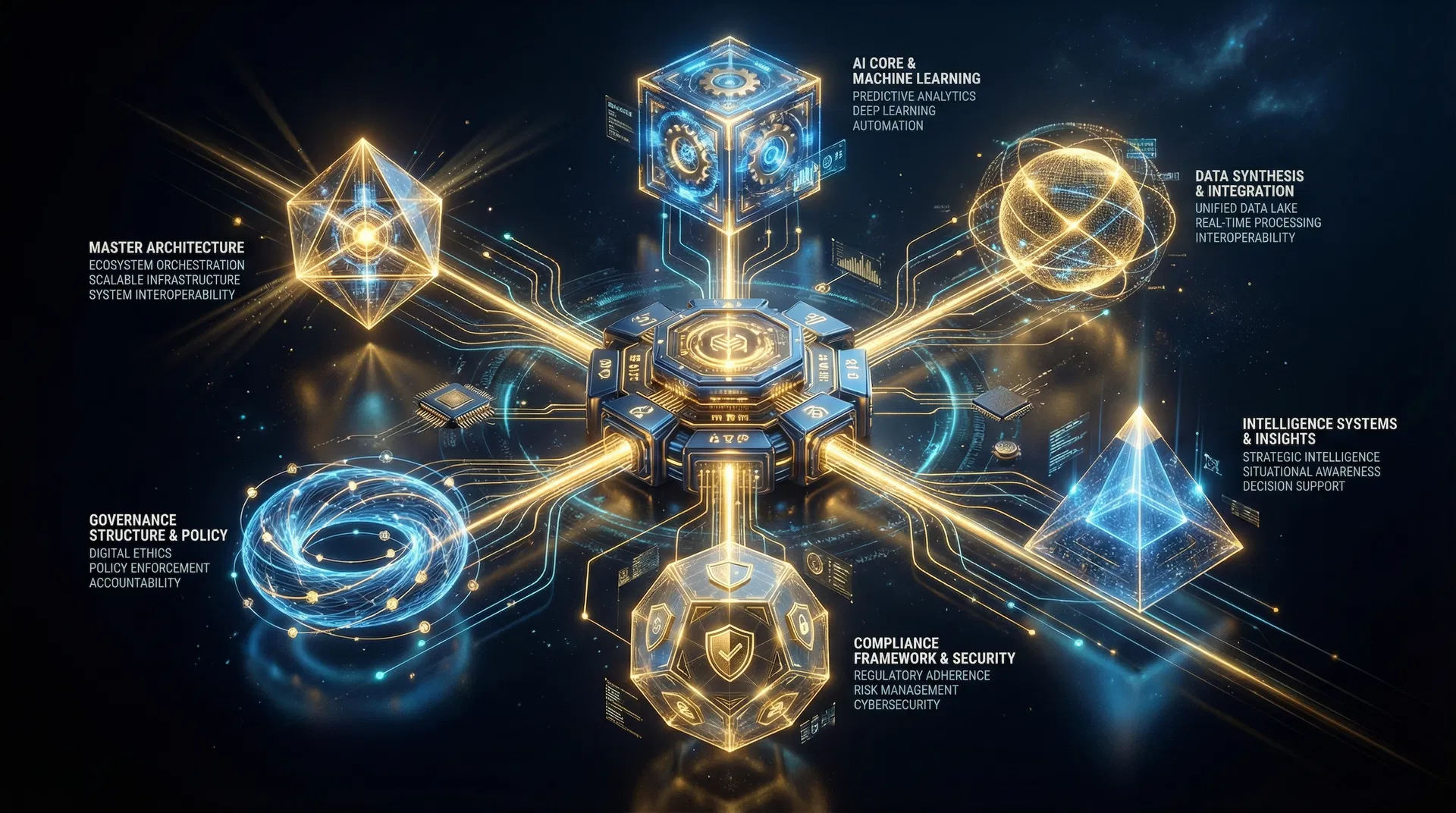
The Architecture of Sovereignty
Twelve foundational frameworks power the KRYOS HyperCube, the commercial intelligence infrastructure at the core of KRYOS Dynamics. Each is engineered for deterministic operation, forensic auditability, and institutional-grade reliability across 30+ operational verticals.
ARCS / ARCF
Adaptive Regulatory Compliance System & Framework
Proprietary compliance systems integrated into KRYOS HyperCube. ARCS handles dynamic regulatory adaptation across jurisdictions while ARCF provides the structural framework for compliance verification. Together they gate every pipeline action with fail-closed logic, generating tamper-evident audit certificates and maintaining full provenance traceability using SHA-256 forensic hash chains.
OmniSynth
Cross-Domain Synthesis & Contradiction Resolution Engine
Executive synthesis kernel that fuses only contradiction-cleared, compliance-certified outputs from disparate domains into unified analytical models. Integrates hybrid quantum-classical optimization algorithms (QAOA, VQE) to accelerate contradiction closure and memory synthesis. Quality Decision Score thresholds and Crystalline Lattice quarantine guarantee enforcement on evidence or compliance drift.
Helios MPPT
Multi-Phase Processing Technology & Oasis Agent Mesh
The operational heart of KRYOS HyperCube. Orchestrates up to one million persistent-memory agents per cube into deterministic roles: Analyst, Compliance, Sentinel, Adversarial, Synthesis, and SuperAgent. Each agent operates within mathematically isolated micro-domains, ensuring scenario-complete coverage, zero analytic drift, and rapidly adaptable specialization across operational verticals.
QNSPR
Quantum-Normalized Scenario Provenance Registry
The evidentiary backbone of the HyperCube mesh. Every analytic, decision, memory event, and scenario output is exhaustively labeled [FACT], [INFERRED], [UNKNOWN], or [WITHHELD ON GAP]. This atomic tagging enables full boardroom, regulatory, and auditor traceability from signal intake to executive dashboard, making every output defensible in legal and adversarial review.
SINE v2.0
Semantic Instruction / Niche Engine
Works in tandem with HPAS to canonically define the framework for deterministic agent sharding, allocating non-overlapping, compliance-tethered roles per agent within each cube. Multi-level partitioning makes the mesh resilient against mission drift, security leak, or governance ambiguity while enabling rapidly adaptable specialization as regulatory regimes shift.
HPAS
Hypercube Partitioned Assignment Strategy
Mathematical partitioning framework that assigns each agent to a tightly bounded micro-niche through hard mathematical isolation. Ensures that no two agents overlap in analytical scope, preventing cross-contamination between analytical threads while maintaining independent evidence chains and full auditability across the entire agent mesh.
PROMPTFORGE Ω
Enterprise Schema-Lock & Intake Normalization Core
Governs all intake normalization, forcibly schema-locking every incoming codebase, data payload, or prompt prior to mesh entry. Systematically decomposes complex, multi-vertical data and intent into QNSPR-labeled atomic tasks, eliminating ambiguity, contradiction, and regulatory blind spots for every agentic operation. Quarantines potentially hazardous or out-of-policy signals before processing.
PeriodMerge
Temporal Contradiction Resolution & Scenario Fusion
Orchestration engine that performs contradiction-resilient fusion of all agent-sourced, compliance-cleared scenario branches into a single, final, scenario-complete intelligence output. Works alongside OmniSynth to close contradiction loops and merge temporal analysis threads into deterministic decision packages with full audit lineage.
ACE Lattice
Adversarial Consistency Engine
Automated red-teaming system that stress-tests every conclusion through adversarial challenge protocols before it can exit the intelligence pipeline. Detects logical inconsistencies, evidential gaps, and reasoning failures across agent findings. No output passes to Decision Synthesis without surviving ACE Lattice scrutiny, ensuring institutional-grade reliability.
V-Framework
Recursive Intelligence & Sovereign Systems Methodology
The methodology used for building self-sustaining community capabilities that compound over time and retain full ownership and control. Eliminates external dependencies by transferring permanent, enterprise-grade infrastructure rather than temporary grants. Organizations receive AI tools, cybersecurity frameworks, compliance engines, and governance systems that remain with them indefinitely.
Crystalline Lattice
Contradiction Quarantine & Quality Enforcement
Quality enforcement mechanism that quarantines analytical outputs exhibiting evidence drift, contradiction, or compliance deviation. Works with ACIE to embargo enforcement scenarios when Quality Decision Score thresholds are not met, preventing unverified or inconsistent intelligence from reaching decision-makers. Ensures every output meets institutional-grade standards.
Leverage Pyramid
Stakeholder Influence Architecture
Strategic sequencing model that activates stakeholders from Frontline Advocates up to Top-Tier Policymakers in the optimal order to maximize policy impact. Provides the strategic architecture for the Embassy Row Project's engagement model, ensuring that capability transfers reach the institutions and decision-makers where they create the greatest systemic effect.
Embassy Row Project Institutes
Each operates independently with its own mission, leadership, and outputs, but all share Scott's principles of transparency, capability transfer, and public-interest architecture.
Cybersecurity, Intelligence & Critical Infrastructure
3 institutesAI, Simulation & Compliance Architecture
4 institutesBioengineering, MedTech & Health Innovation
4 institutesLaw, Governance & Civil Liberties
2 institutesClimate, Environment & Decarbonization
3 institutesChild Protection & Youth Empowerment
3 institutesEconomics, Geopolitics & Development
2 institutesCulture, Resilience & Humanitarian Work
4 institutesIndependence, Composure & Non-Reaction
Scott does not defend his work publicly, does not engage in social-media disputes, and does not react to provocation. He publishes frameworks, not counterarguments. He builds institutions, not explanations.
Do not inherit the narrative. Define the structure.
Do not defend. Demonstrate.
Do not react. Reshape.
Do not seek permission. Build capability.
What the Systems Have Delivered
Strengthened critical-infrastructure resilience across multiple nations
Equipped thousands of youth with cybersecurity and STEM careers
Enabled survivor-led anti-trafficking programs
Scaled carbon-market access in emerging economies
Advanced bioengineering and MedTech policy
Preserved cultural memory in post-conflict regions
Delivered decision-intelligence tools to ministries, NGOs, and research labs
Provided journalists with accurate, noncommercial threat intelligence
Created self-sustaining ecosystems where capability multiplies across generations
"No one person should be able to build and fund an ecosystem of AI, cyber, privacy, climate, and governance frameworks and then simply hand it to the world. And yet, James Scott has quietly done exactly that."
From whoisjamesscott.com
Explore the Ecosystem
Discover the commercial intelligence infrastructure, proprietary frameworks, and pro bono institutes that James Scott has built through KRYOS Dynamics and the Embassy Row Project.